 Interview Sarthi
Home › Guides › Self-introduction
Self-introduction for interviews: the 30-second structure
One structure that survives pressure, with worked templates in English and Hinglish: fresher, experienced, and career-gap versions.
How to use these examples: These are our practice suggestions, not employer rules or guaranteed answers. Replace the situations, numbers and results with your own experience.
“Tell me about yourself”, or “apne baare mein bataiye”, opens almost every interview in India, and it is the answer most people prepare worst. Not because it is hard, but because they prepare a paragraph when they should prepare a structure. A memorised paragraph collapses the moment nerves hit or the interviewer interrupts. A structure survives both.
The structure: present → proof → next
Three beats, thirty to forty-five seconds, in this order:
- Present: who you are professionally, right now, in one sentence. Role, experience, main skill.
- Proof: one concrete thing you did, with a number in it. Not three things. One, with a number.
- Next: what you are looking for, phrased so it points at this job.
Why it works: the introduction is a menu, not the meal. Its only job is to hand the interviewer two or three threads worth pulling. The number in your proof beat is deliberately a hook . Interviewers almost always ask about it, and now the interview is running on ground you chose.
What to leave out
- “Myself Rahul…”: say “I'm Rahul”. Small thing, heard fifty times a day, easy to fix.
- Family, birthplace, schooling, hobbies, unless asked. “I belong to Kanpur, my father is a teacher” spends your best thirty seconds on things that cannot get you hired.
- Your whole resume in order. They have the resume. Reading it back is the fastest way to lose the room.
- Adjectives about yourself. “I am hardworking and sincere” is a claim; “we cut load time from 3 seconds to 1.2” is evidence. Evidence wins.
Worked templates
Experienced candidate (English)
“I'm a frontend developer with 3 years of experience, mostly in React. Right now I own the product dashboard at my company, about 40,000 users, and my favourite work there has been performance: last quarter we took load time from 3 seconds to 1.2. I'm looking for a team with bigger scale and more ownership, which is why this role caught my eye.”
Present (one sentence) → proof (one project, two numbers) → next (points at their job). About 25 seconds out loud.
Experienced candidate (Hinglish: use only if the interviewer opened in Hindi/Hinglish)
“Main frontend developer hoon, 3 saal ka experience, mostly React mein. Abhi main product dashboard handle karta hoon jo 40k users use karte hain. Sabse achha kaam wahan performance ka raha. Pichle quarter humne load time 3 second se 1.2 pe laaya. Ab main aisi team dhoondh raha hoon jahan scale bada ho aur ownership zyada mile.”
Same three beats. Technical nouns and every number stay in English. That is how natural Hinglish actually sounds. More on the craft: answering in Hinglish without sounding unprofessional.
Fresher (English)
“I'm Priya, a final-year computer science student at - college name. For my major project I built an attendance system that my department actually uses now. Around 300 students are on it daily, and building the face-recognition part taught me more Python than three years of classes did. I'm looking for a role where I can do that kind of end-to-end building with a real team around me.”
No work experience needed. The proof beat is a project with a deployment and a number. “My department uses it” beats any list of programming languages.
After a career gap
“I'm a QA engineer with 4 years of experience, the last two in automation with Selenium. I took 8 months off in 2025 for a family health situation. During that time I kept my hands warm with two freelance testing projects. Since January I've been fully back, and I'm looking for a stable automation role where I can go deep rather than wide.”
Name the gap yourself, one line, no oversharing, then move on. Raising it first removes its power as a gotcha. Full treatment of the gap question: 10 HR questions with Hinglish answers.
Delivery: the part nobody practises
Say it out loud five times before the interview, not in your head, out loud. Reading silently and speaking under pressure are different skills, and the first time your mouth forms these sentences should not be on the call. You are checking two things: that it lands under 45 seconds, and that it ends cleanly instead of trailing into “…so yeah, that's me.” End on the “next” beat and stop talking. The silence after is the interviewer's job to fill, not yours.
If your interviews are online, one more edge: keep the three beats as three keywords on a sticky note beside your camera, not sentences, keywords. Glancing at “dashboard / 3s→1.2s / ownership” restarts your memory without making you read. More setup tricks like this in how to stop blanking out in online interviews.
Practise these answers out loud
Prep Sarthi runs a voice AI mock interview from your CV and target role, asks follow-up questions and gives feedback on weak answers. Try a free 7-minute demo, with nothing to set up; a paid pass is ₹99 for 30 days.
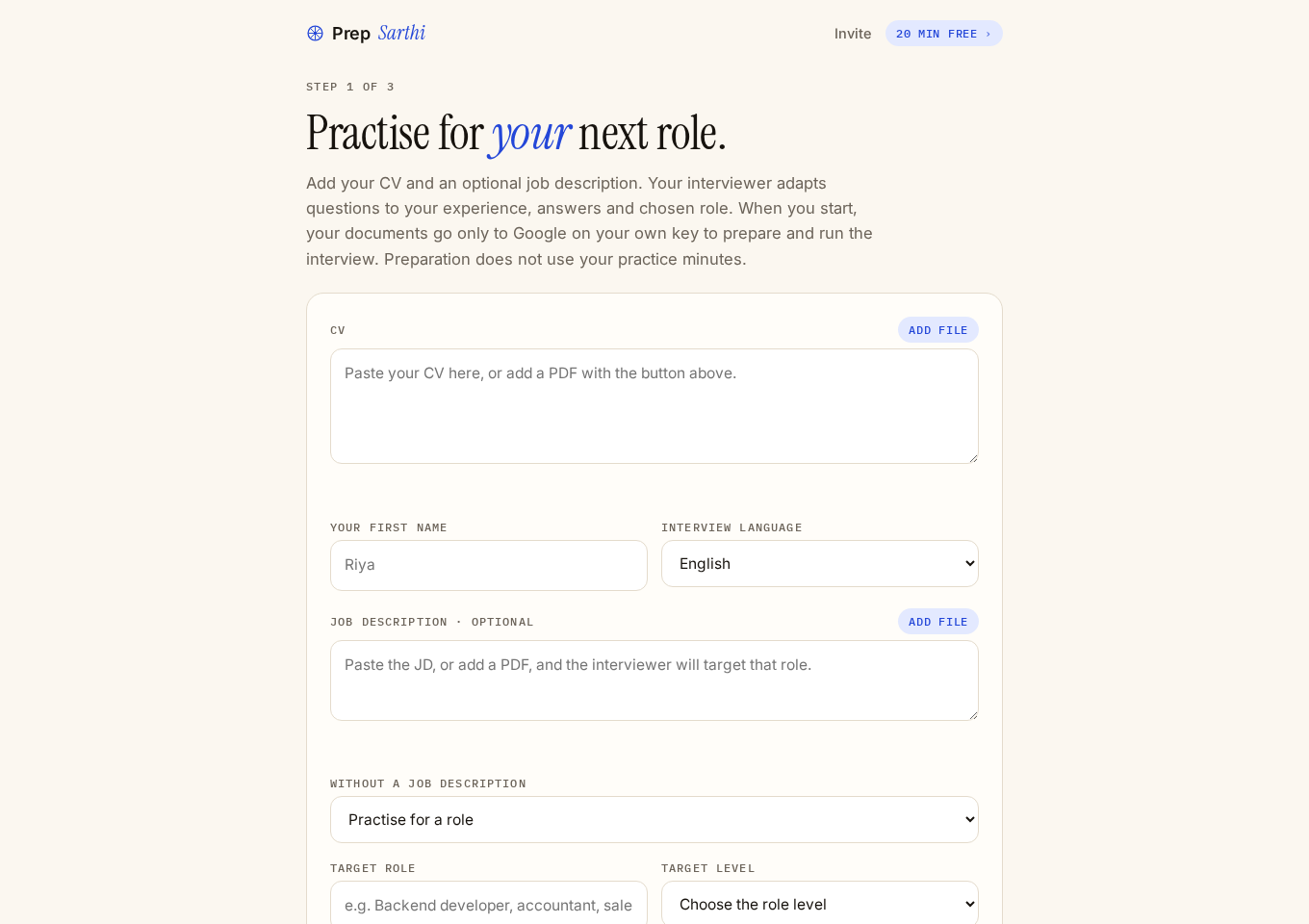 Try a free AI mock interview
See how to practise from your resume. Still looking for a role? Apply Sarthi brings jobs from multiple sources together. For permitted assistance during a real call, see Live Sarthi.