 Interview Sarthi
Home › Guides › Explaining a career gap
How to explain a career gap: every type, with scripts
The gap is not the problem. The flinch is. One formula, then a script for each kind of gap: health, family, layoff, exam prep, a startup that didn't work.
How to use these examples: These are our practice suggestions, not employer rules or guaranteed answers. Replace the situations, numbers and results with your own experience.
Here is the thing interviewers know that candidates forget: they have seen hundreds of gaps. Layoffs, illness, caregiving, failed attempts at something brave. None of it is new to the person across the table. What they are actually assessing when they ask “ye gap kyun hai?” is not the gap. It's whether you panic, whether you over-explain, whether the story is coherent, because composure about your own history predicts composure in the job.
The formula: reason → what you did anyway → proof it's over
- Reason, one line, no oversharing. “A family health situation: I was the primary caretaker.” Done. Detail invites follow-ups you don't want.
- What you did during it. Freelance projects, a certification, kept a skill warm, or simply handled the responsibility well. Something moved.
- Proof it's over. The strongest close there is: “the situation is fully resolved, and here's my record since.” No trailing off.
Thirty seconds, said calmly, then stop talking. The most common failure is not a bad reason. It's a good reason delivered with apology in the voice and three unnecessary paragraphs. Practise your gap answer out loud until it sounds as boring as your name. Boring is what closure sounds like.
Scripts by type of gap
Health (yours)
“I took 10 months off in 2025 for a health issue that needed proper treatment. It's fully resolved, my doctor and I closed that chapter in March, and I eased back in with two freelance projects before returning to full-time search. I'm at 100% and ready for a full workload.”
Share only the detail needed to explain your availability. Do not say a condition is fully resolved unless that is true; explain any current work arrangements you need.
Family / caregiving (Hinglish)
“2024 mein 8 mahine ka gap hai: father ki illness thi, main hi primary caretaker tha. Us dauran maine do chhote freelance projects kiye taaki haath chalta rahe. Ab situation fully sorted hai, aur pichhle ek saal ka full-time record aap dekh sakte hain.”
Reason (one line) → hands kept warm → closed with the record since. This is the answer from our 10 HR questions guide, and it survives every follow-up.
Layoff
“My role went in the company's 15% layoff in January. The whole vertical was cut, along with my manager's. I gave myself two weeks to reset, then treated the search like a job: mornings for upskilling, I finished the AWS associate cert, afternoons for applications. That's why the gap is 4 months and the skills are current.”
A layoff wasn't your decision, and interviewers know the market, zero shame, immediate pivot to what you built. Never dress a layoff up as a resignation; verification can surface it, and the truth here doesn't hurt you.
Exam preparation (UPSC, banking, GATE): the most Indian gap there is
“I gave two committed years to UPSC preparation: reached the mains stage, didn't clear it, and made a considered decision against a third attempt. What those years actually built: the discipline to study 8 hours a day, and calm in high-pressure evaluations. For the last 4 months I've converted that discipline into upskilling, [course/project], which is why I'm sitting here prepared rather than rusty.”
The single thing the interviewer needs to hear: the exam chapter is closed. Their fear isn't the gap; it's that you'll leave next April for another attempt. Close the door explicitly.
A startup or freelancing stint that didn't work out
“I spent a year building a product with a friend. We got to paying users but not to sustainable revenue, and we shut it down honestly rather than drift. It was the most educational year of my career: I shipped end-to-end, talked to customers weekly, and learned what a business actually costs. I'm now looking for scale and structure: the things a startup of two can't give.”
A failed startup framed with ownership reads as experience, not as a gap at all. Numbers ("paying users", "a year") keep it concrete.
The gap that's still open (you're in it now)
“The gap is current: 6 months. The first three were [reason]; since then I've been searching properly, and deliberately not grabbing the first offer. I'm optimising for a role I'll stay in, which is why I'm being selective. In parallel I've kept building: [course/project].”
"Selective, not idle" is the honest frame, and it flatters the role you're interviewing for.
What never to say
- “I couldn't find a job.” Even when true, reframe to what you did about it. The market is allowed to be hard; passivity is what reads badly.
- A different story than your documents tell. Dates on relieving letters and payslips surface in background verification at every large company. Build the story on what the paper shows.
- Oversharing. Medical details, family conflict, financial stress: one line of reason is composure; five lines is a red flag you handed over voluntarily.
- Apologising. “Sorry, I know the gap looks bad…” instructs the interviewer to think it's bad. State; don't plead.
On the resume itself
Don't hide the gap with fake dates. Verification kills offers over exactly this. Do consider a single honest line in the resume where the gap sits (“2024: family caregiving; freelance projects” or “2023–2025: UPSC preparation, mains stage”): it answers the question before the phone screen, filters out the companies who'd hold it against you anyway, and means the interview question becomes a confirmation rather than an ambush. Then your self-introduction names it proactively in one clause. Raising it first removes its power entirely.
Practise these answers out loud
Prep Sarthi runs a voice AI mock interview from your CV and target role, asks follow-up questions and gives feedback on weak answers. Try a free 7-minute demo, with nothing to set up; a paid pass is ₹99 for 30 days.
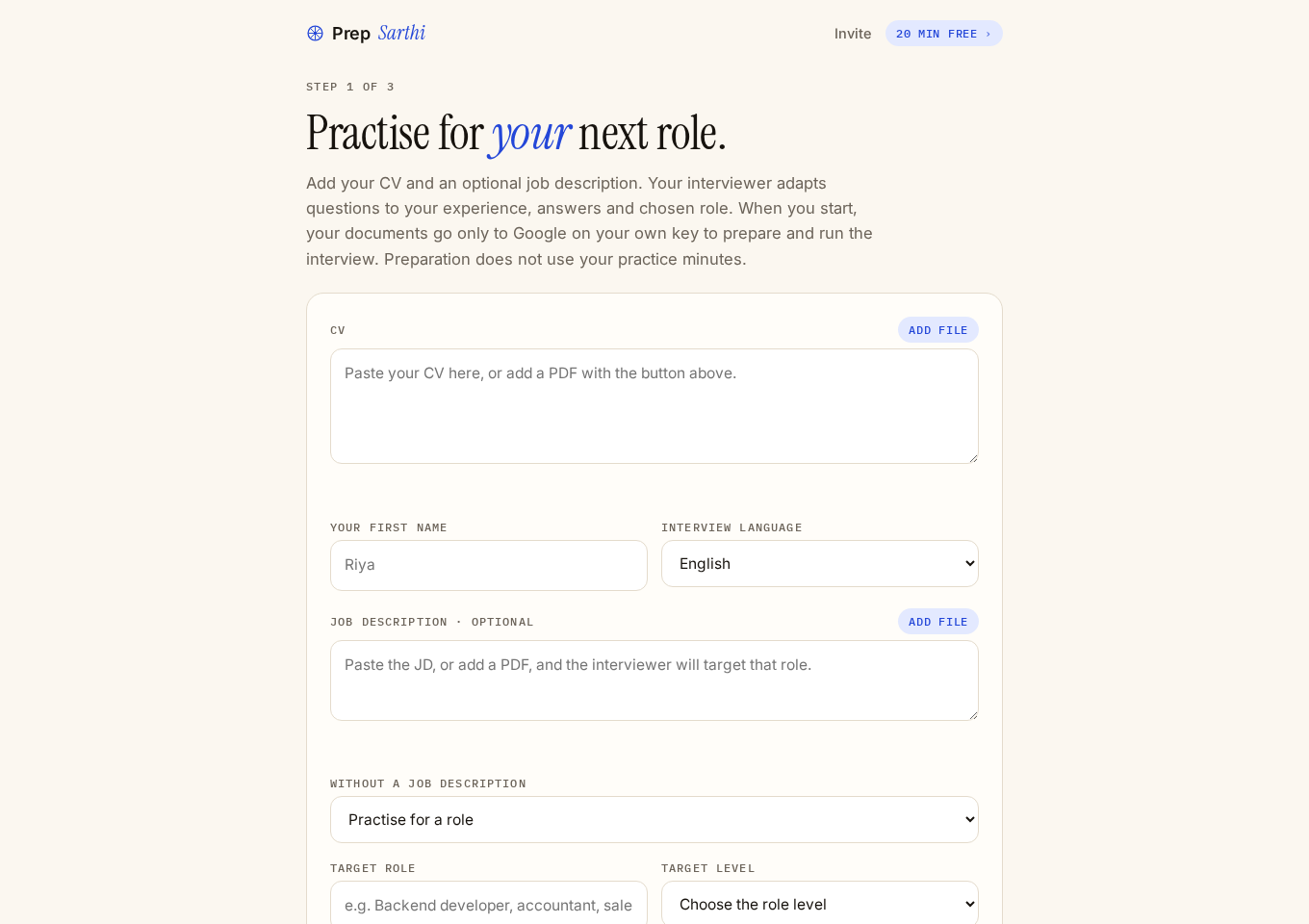 Try a free AI mock interview
See how to practise from your resume. Still looking for a role? Apply Sarthi brings jobs from multiple sources together. For permitted assistance during a real call, see Live Sarthi.