 Interview Sarthi
Home › Guides › Strengths and weaknesses
Strengths and weaknesses: answers that don't sound rehearsed
The strength must come with proof, and the weakness must come with a system. Everything else is either bragging or evasion, and interviewers have heard both all day.
How to use these examples: These are our practice suggestions, not employer rules or guaranteed answers. Replace the situations, numbers and results with your own experience.
This is the question where prepared candidates sound worst, because most preparation for it is learning an evasion: a strength that's an adjective list, and a weakness that's secretly a strength. “I'm a perfectionist. I work too hard.” The interviewer asked a self-awareness question and received a dodge. And self-awareness was the thing being graded.
Strengths: one claim, one proof
Pick one or two strengths, chosen by one criterion: does the job description need it, and can you prove it with a story that has a number in it? The proof is the answer; the label is just its heading.
Weak version
“My strengths are problem-solving, quick learning, and teamwork.”
Three unverifiable claims. The interviewer's pen doesn't move.
Strong version (English)
“My main strength is debugging production issues under pressure. Last year I closed about 40% of our team's critical incidents, including one memory leak that had been open for three weeks before it landed with me, found it in two days by bisecting the deploy history. If your on-call rotation is busy, that's where I'll be useful fastest.”
Label → number → one story with a method in it → mapped to their need. Same shape as “why should we hire you?”, because it's secretly the same question.
Strong version (Hinglish, if the interviewer switched first)
“Meri strength production debugging hai, pressure mein. Pichle saal team ke critical incidents ka 40% maine close kiya, ek memory leak jo teen hafte se open tha, wo deploy history bisect karke do din mein mila. Agar aapka on-call busy rehta hai, toh main wahan sabse jaldi useful hounga.”
Numbers and technical nouns in English, as always: the Hinglish rules.
Weaknesses: the formula is weakness + system
A real weakness, plus evidence it cost you something, plus the specific habit you built around it, plus an honest status report. Four beats:
Worked example (English)
“I'm slow to delegate. My instinct is that doing it myself is faster. Last year that made me the bottleneck in a sprint: three tasks waiting on me that teammates could have done. So I made a rule: anything someone else can do 80% as well, I hand over and only review. I still catch myself hoarding tasks sometimes, but my juniors ship more now and I've stopped being the slowest path.”
Real weakness → real cost → a rule, not a vibe (“the 80% rule”) → honest status. This answer raises the candidate's stock. It demonstrates exactly the self-management being tested.
Worked example (Hinglish)
“Main delegate karne mein slow hoon. Lagta hai khud karunga toh jaldi hoga. Pichle saal isse sprint mein bottleneck bana, toh maine rule banaya: jo task koi aur 80% kar sakta hai, wo main de deta hoon aur sirf review karta hoon. Abhi bhi perfect nahi hoon ispe, par pehle se kaafi behtar. Aur team zyada ship kar rahi hai.”
Same four beats, natural register.
Weaknesses that work, and the ones that don't
- Safe and real: slow to delegate · over-detailed in code reviews · uncomfortable presenting to big groups · saying yes to too much and overcommitting · going too deep before asking for help · weak at documenting as you go. Each has a believable system you can describe.
- Never the fake ones: “I'm a perfectionist”, “I work too hard”, “I care too much”. These are evasions wearing a costume, and every interviewer has heard them this week.
- Never a disqualifier: match the weakness to the role's edges, not its centre. A backend developer can be average at public speaking; a sales candidate cannot. A data analyst can overcommit; an air-traffic controller should not say “attention to detail”.
- Never a character flaw: temper, honesty, punctuality, “I get bored easily”. The question is about work habits, not vices.
If they push for a second weakness, some interviewers do, precisely to get past your prepared one, have a smaller, honest spare ready (“my documentation lags my code; I now block 30 minutes every Friday for it”). The second answer sounding as calm as the first is the actual test.
Both halves of this question belong to the same story as your self-introduction and reason for change: the strength should be the thing your intro promised, and the weakness's system should sound like someone who'll grow in the role. Interviewers cross-check; prepare the set together, then say each out loud once. The rehearsal advice in stop blanking out applies here word for word.
Practise these answers out loud
Prep Sarthi runs a voice AI mock interview from your CV and target role, asks follow-up questions and gives feedback on weak answers. Try a free 7-minute demo, with nothing to set up; a paid pass is ₹99 for 30 days.
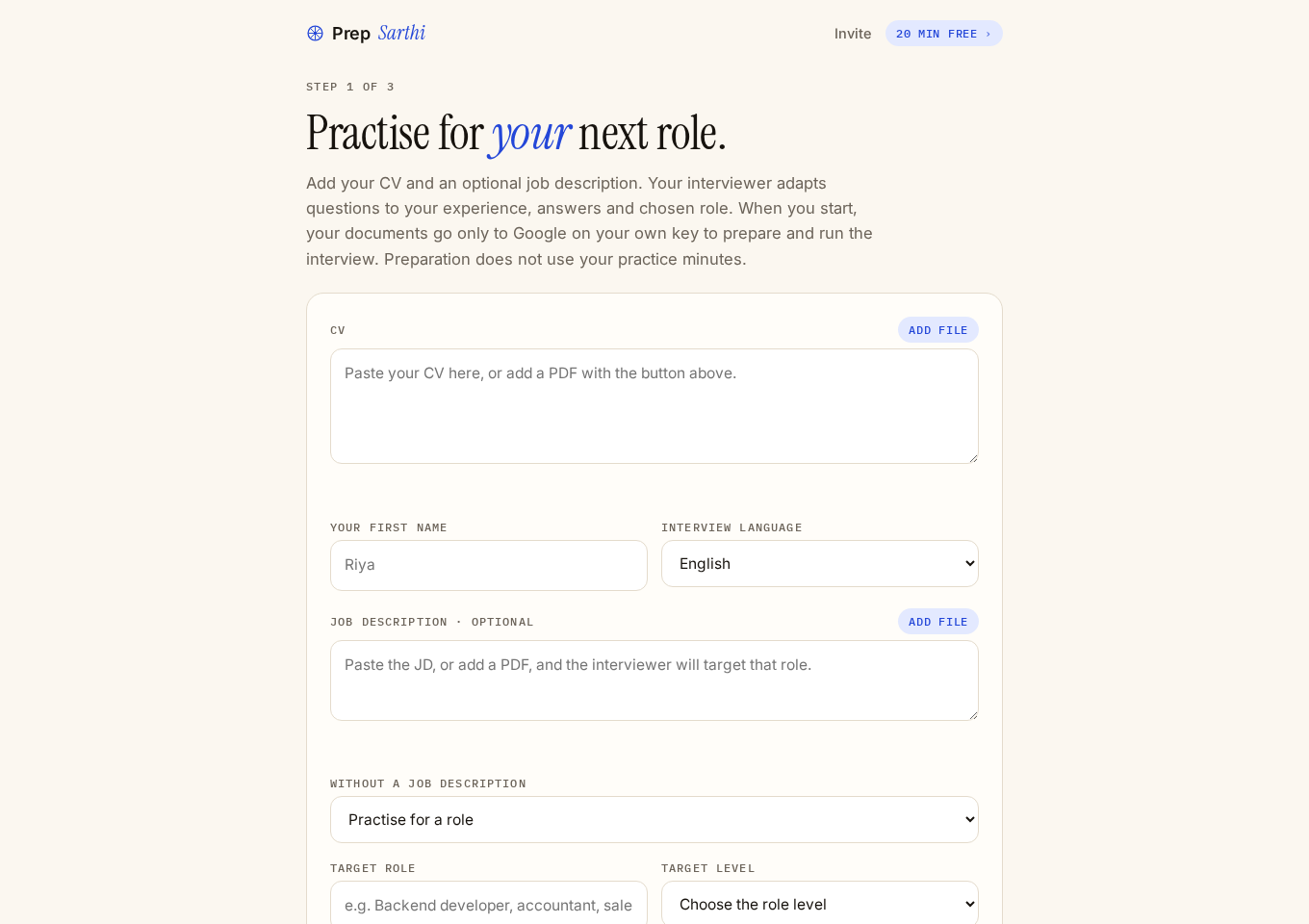 Try a free AI mock interview
See how to practise from your resume. Still looking for a role? Apply Sarthi brings jobs from multiple sources together. For permitted assistance during a real call, see Live Sarthi.