 Interview Sarthi
Home › Guides › First job interview guide
Your first job interview: the complete fresher guide
Prepare to explain your projects, answer common HR questions and handle the practical details of your first interview. These are suggested exercises, not a guaranteed question list.
How to use these examples: These are our practice suggestions, not employer rules or guaranteed answers. Replace the situations, numbers and results with your own experience.
What you're actually being judged on
Freshers prepare as if the interview is a knowledge exam. It mostly isn't. With no work history to probe, the interviewer is estimating four things:
- Can you explain your own project? The single biggest differentiator. Not list it, explain it: what problem, what you built, what broke, what you'd do differently.
- Do you communicate in organised thoughts? Complete sentences, answers with a beginning and an end. This matters double at services companies, where the HR round is quietly a communication test.
- Are you trainable and likely to stay? Curiosity, coachability, and no announced exit plans.
- Is your story consistent? Resume, application form, and spoken answers must agree.
The one-project rule: pick your best project and prepare it three levels deep: the one-line summary, the two-minute walkthrough, and the deep dive (why this stack, what failed, the hardest bug, what you'd change). One project you can defend beats five you can only name, and explaining your own project is a useful exercise for many technical roles.
Five questions worth practising
- “Tell me about yourself.” Thirty seconds: who you are, one project with a number in it, what you're looking for. Full structure and fresher templates: the self-introduction guide.
- “Explain your final-year project.” The one-project rule above. Lead with the problem, not the tech stack: “attendance was manual, so I built…” beats “I used React and Flask…”.
- “Why this company?” One researched sentence clears a bar most candidates miss: what they do, one thing you read, why it fits you. Five minutes on their site the night before.
- “Strengths and weaknesses?” A strength with proof, a real weakness with the habit you built around it, never “I'm a perfectionist”. Worked answers: the strengths & weaknesses guide.
- “Any questions for us?” Always ask. Two that work everywhere: “what does success look like at 90 days?” and “what does the training period actually cover?”
Read the package in the posting, if one is listed. Ask about unclear components before accepting. If compensation is open for discussion, use the salary expectation practice guide.
Check your documents and interview setup
In person
- Documents: 2–3 printed resumes; all marksheets (10th, 12th, every semester); degree or provisional certificate; government photo ID; passport photos; internship/course certificates. Originals + one photocopy set, in a folder, the night before.
- Dress: formal or clean business-casual. A plain ironed shirt is never wrong in India. You will not be rejected for being slightly too formal; the reverse is possible.
- Time: plan to be in the building 20 minutes early. A late fresher is a decided fresher.
Online interviews
- One test call with a friend on the same platform. Check that your microphone, earphones and connection work reliably.
- Camera at eye level, plain background, phone silent and out of reach.
- Notes as a map, not a script: 5–6 keywords on a sticky note beside the camera. Glancing at keywords restarts memory; reading paragraphs is instantly visible. The full online toolkit, including what to do when your mind blanks anyway, is in stop blanking out in online interviews.
- Know what screen share actually shows before anyone asks you to share: the plain-English guide.
During: three rules
- Pause before answering. Three silent seconds after each question reads as thoughtful and stops the ramble before it starts.
- “I don't know, but…” beats bluffing. “I haven't used Docker, but I understand it packages apps with their dependencies. I'd pick it up fast” is a good fresher answer. A caught bluff ends interviews; an honest edge doesn't.
- Match the interviewer's language. If they relax into Hindi, natural Hinglish is fine. Technical words and numbers stay in English. The craft: the Hinglish guide; the ten standard HR questions with Hinglish answers: here.
After
Same day, send a two-line thank-you email to HR: appreciation plus one specific thing from the conversation. Two lines, no essay. Most freshers send nothing, so two lines stand out. Then keep interviewing elsewhere until an offer letter is in hand: a “positive HR round” is not an offer, and treating it as one is the most common fresher mistake of all. If a week passes beyond their stated timeline, one polite follow-up is professional, not desperate.
Practise these answers out loud
Prep Sarthi runs a voice AI mock interview from your CV and target role, asks follow-up questions and gives feedback on weak answers. Try a free 7-minute demo, with nothing to set up; a paid pass is ₹99 for 30 days.
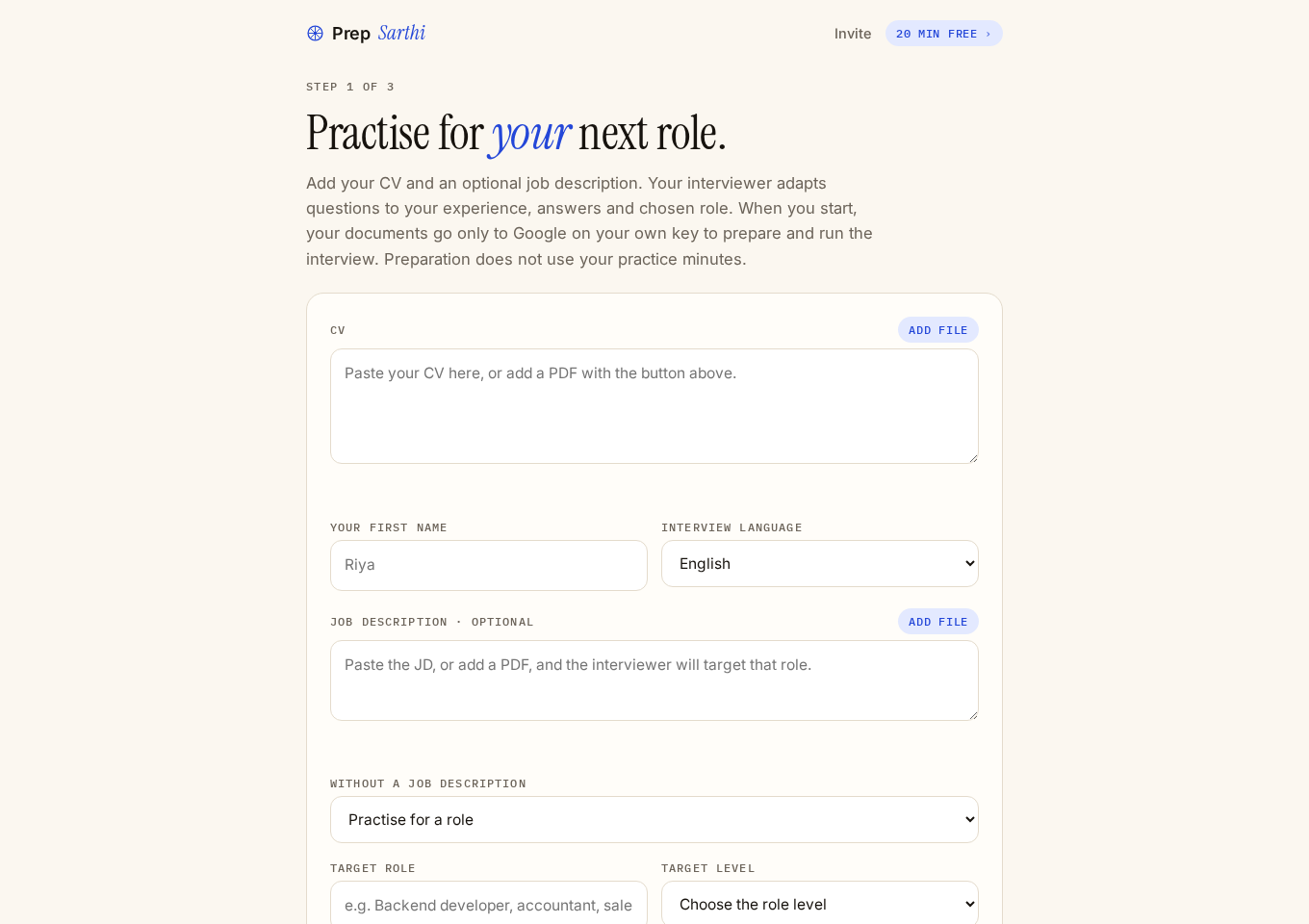 Try a free AI mock interview
See how to practise from your resume. Still looking for a role? Apply Sarthi brings jobs from multiple sources together. For permitted assistance during a real call, see Live Sarthi.